Miretti: The Delicate Script That Elevates Your Design Without the Clutter
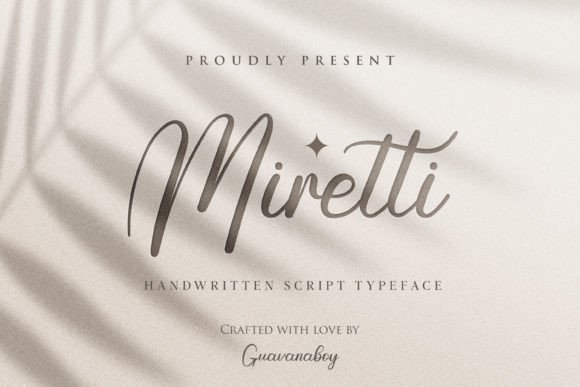
In a digital landscape often dominated by rigid sans-serifs and heavy geometric forms, Miretti stands out as a breath of fresh air. It is not merely a typeface; it is a statement of elegance and class designed specifically for those who understand that sometimes less is more, but with a touch of human warmth. If you are a small business owner looking to brand your boutique, a blogger seeking a unique voice, or a designer trying to inject personality into a corporate project, this lovely script font offers a refreshing look that can transform a flat design into something memorable.
However, just because Miretti exudes beauty does not mean it is a plug-and-play solution for every scenario. Many creators fall into the trap of assuming that "delicate" automatically means "easy to use." This assumption often leads to projects that look unfinished rather than refined. To get the most out of this typeface, you need to understand its nuances, avoid common pitfalls regarding readability and context, and apply it with intention.
The Allure of Elegance and Where It Fits Best
Miretti was crafted with a specific intent: to bring a beautiful and refreshing aesthetic to designs that require a touch of sophistication. Its strokes are fluid yet controlled, capturing the essence of hand-lettering without the unpredictability of actual ink on paper. This makes it an excellent choice for wedding invitations, luxury packaging, lifestyle blogs, and editorial headers where a personal connection is vital.
When used correctly, Miretti creates an immediate emotional resonance. It signals to the viewer that care has been taken in the creation of the content. For entrepreneurs and freelancers, leveraging this font can elevate the perceived value of their services or products. A logo or tagline set in Miretti suggests attention to detail, which builds trust with potential customers aged 20 to 50 who appreciate authenticity over mass-produced uniformity.
Common Pitfalls When Using Script Fonts
Despite its charm, Miretti is frequently misused. The most prevalent error is treating a delicate script as a primary body text tool. Because the characters are thin and intricate, they lack the visual weight required for long-form reading. If you attempt to set a paragraph of blog copy or a legal disclaimer in Miretti, you will likely find that your audience struggles to decode the message. This directly impacts usability and efficiency; if users have to squint or pause to read your content, they are more likely to leave your page entirely.
Another frequent mistake involves ignoring the spacing between letters (kerning) and lines (leading). Script fonts rely heavily on the negative space around them to breathe. When letters are too tight, the delicate flourishes collide, creating a muddy blob that obscures the letterforms. Conversely, when the spacing is too wide, the flow of the script breaks, destroying the illusion of handwriting. This oversight affects the overall quality and presentation of your design, making it look amateurish rather than elegant.
Furthermore, many designers overlook the importance of contrast. Pairing Miretti with another decorative or equally busy font is a recipe for visual chaos. The eye needs a resting place to appreciate the script's details. Without a strong structural partner, such as a clean sans-serif or a sturdy serif, the Miretti text can feel lost or disconnected from the rest of the layout.
Why Context Matters More Than You Think
Before downloading or purchasing Miretti, consider the medium where it will live. On high-resolution desktop screens, the fine details of the font render beautifully. However, on smaller mobile devices or low-quality prints, these same details can vanish or become jagged. This technical limitation can significantly affect satisfaction and communication. A client might love the font on their laptop but be frustrated when they receive a printed flyer where the text looks faint or broken.
To avoid this, always test your designs at actual size before finalizing them. Check how the font behaves in both light and dark modes if it is for a web application. Ensure that the stroke width remains legible even when scaled down. If the text becomes illegible at smaller sizes, you may need to adjust the weight or switch to a simpler alternative for subheadings and captions.
Practical Strategies for Success
Avoiding these mistakes requires a shift in mindset from "this looks pretty" to "this works well." Here are practical steps to ensure your use of Miretti enhances your project rather than hindering it.
- Pair with Purpose: Always pair Miretti with a neutral, highly readable font for body text. A modern sans-serif like Helvetica or a classic serif like Garamond provides the necessary structure to let the script shine without competing for attention.
- Master the Spacing: Do not rely solely on auto-tracking. Manually adjust the kerning for critical words, especially those with curves meeting vertical lines. Increase line height to at least 1.4 or 1.5 times the font size to prevent the descenders and ascenders from colliding.
- Limit Usage: Use Miretti sparingly. It is a spotlight, not a floodlight. Reserve it for headlines, quotes, logos, or short phrases. Let the supporting text do the heavy lifting of information delivery.
- Check Color Contrast: Because the font is delicate, high-contrast color combinations are essential. Avoid using light gray text on white backgrounds. Opt for deep blacks, rich charcoals, or bold colors against lighter backgrounds to ensure the thin strokes remain visible.
For educators and marketers, understanding these rules is crucial. A marketing campaign that relies on Miretti for call-to-action buttons might fail if the text is too small to tap or read quickly. Similarly, educational materials need clarity above all else; using Miretti for instructions could confuse learners. By applying these corrections, you ensure that your design serves its functional purpose while maintaining its aesthetic appeal.
Evaluating Before You Commit
When evaluating Miretti for your next project, ask yourself specific questions about the end goal. Does the project require a sense of formality? Is the audience likely to be scanning quickly or reading deeply? If the answer to the latter is yes, reconsider using Miretti for anything other than decorative accents.
Additionally, verify the licensing terms. As a professional-grade font, Miretti often comes with specific usage rights depending on whether it is for commercial print, web embedding, or app development. Ignoring these details can lead to legal issues and unexpected costs later. Ensure you have the appropriate license for your intended platform to protect your investment and your reputation.
Ultimately, Miretti is a powerful tool in the hands of a thoughtful designer. It brings a level of grace that standard fonts simply cannot replicate. By respecting its delicate nature, avoiding the trap of overuse, and focusing on readability, you can create designs that are not only visually stunning but also effective in communicating your message. Whether you are launching a new brand or refreshing an existing one, taking the time to apply Miretti correctly will pay dividends in the quality and impact of your work.
Remember, good design is invisible; it guides the user seamlessly. When Miretti is used with precision, it supports that goal, adding a layer of sophistication that invites the viewer in rather than overwhelming them. With the right approach, this font becomes more than just a style choice—it becomes a strategic asset in your creative toolkit.